Written by Andy Langenkamp , 5th January 2026
From threats to decisive action
Until the end of 2025, the Venezuela dossier could still be read as a game of threats, signals, and calculated ambiguity: Washington increased the pressure, Caracas stood its ground, and analysts mainly debated whether the US would actually take the leap to intervention. That phase is over; the leap has been made. In the first days of the year, US special forces, supported by a broad military and intelligence operation, carried out an action that ended with the capture of Nicolás Maduro and his wife and their transfer to the US. Maduro is being held in New York and will appear in court there.
What makes this moment historic is not only the brutality or audacity, but the type of precedent: a sitting head of state being abducted by the US in his own country and then placed in the American legal system as a criminal suspect.
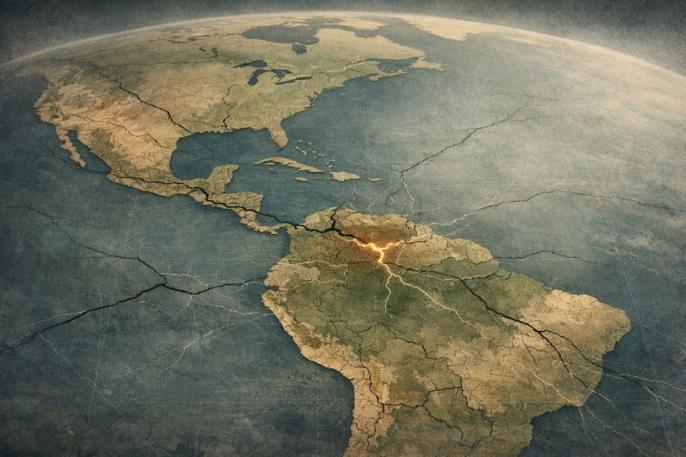
In any case, it should be clear that only the first chapter of this story has been completed and that a whole book will be written about (the consequences of) a fault line in international politics that will cause new shifts; within Venezuela, in the region, in US domestic politics, and in the world order.
The anatomy of the intervention
The best way to describe the intervention is as a 'decapitation operation' in double packaging.
The first package is military: a swift, Hollywood-style action that removes the top of the pyramid without immediately resorting to a classic invasion and occupation. It was a carefully prepared and almost flawlessly executed operation, with air support, cyber support, and intelligence work.
The second package is legal-political: the US government is presenting it not primarily as war, but as a form of law enforcement against the terror of drug criminals — a frame that is intended to normalize the step from sanctions to violence and at the same time avoid a discussion about the president's war powers. However, this legitimisation is already under immediate fire: in the US itself, where Democratic leaders are talking about unconstitutionality and deception, and internationally, where the key question is: what right gives a state the authority to use force on its own in another country to arrest a leader?
Continuity or rupture in Caracas?
Maduro's departure does not automatically mean the end of the regime. The state is not a person, but a network: security services, party structures, economic actors, armed informal groups, etc. This is the crux of the post-intervention problem: the US can remove a person, but it cannot build a new, legitimate, capable, and effective administrative architecture at the same speed.
It has long been clear that America can overthrow regimes/dictators (see Afghanistan and Iraq, among others). The essential question now is whether Washington has a credible endgame and the discipline to stay the course toward that goal when the costs become apparent. This raises three other crucial questions:
- What is the ultimate political goal? Regime change is not an end state. Stability, legitimacy, security, and economic continuity are, but they require long-term engagement and compromises with actors that Washington would prefer to avoid.
- Who trusts whom in the post-Maduro landscape? The intervention has brought the classic commitment problem into sharp focus; or as Colin Powell put it in the ‘Pottery Barn rule’: ‘You need to understand, if you take out a government, take out a regime, guess who becomes the government and regime and is responsible for the country? You are. So if you break it, you own it." Military personnel, Chavista networks, opposition figures, and economic elites all fear retaliation if they turn out to be on the wrong side of history. No one knows who will be pulling the strings and who will be presented with the bill. In such an environment, sabotage, double-dealing, and procrastination are obvious. That is why credible guarantees are needed in the form of amnesty, inclusion, and exit options.
- Can the US scale back in a controlled manner without losing face? The escalation ladder that Washington climbed in 2025 must now be climbed in reverse. Historically, this is more difficult than escalation.
The new Panama or Libya?
The comparison with Panama (the removal of Manuel Noriega in 1989) is tempting: a leader is arrested on drug charges, the US intervenes in its backyard, and the regime is dismantled. But the scale and context are different. Venezuela is larger, more deeply damaged socially and institutionally, and much more heavily intertwined economically with oil, sanctions, and world politics.
The comparison with Libya is equally tempting: a regime is broken, the top disappears, and then the real problem begins — fragmentation, militias, parallel power structures, chaos.
And yet Venezuela is also different: the state has been eroded, but not emptied; there are still institutions, there are still command structures. Moreover, Venezuela is not a closed theater: every major shock in Caracas has an almost immediate impact on the borders with Colombia and Brazil. Towards Colombia in particular, there is a high risk that additional migration and the regrouping of smuggling and armed networks will converge. If Venezuelan security services weaken or reposition themselves, this will create space for groups already active in the border area to take over routes and border crossings.
The correct conclusion is therefore not "this will become Panama" or "this will become Libya," but that the intervention pushes Venezuela into a transition zone in which both outcomes are possible and where the path depends on, among other things, the security/cohesion of the power system and the potential economic oxygen of oil exports and sanctions relief.
Why Venezuela is much more than oil
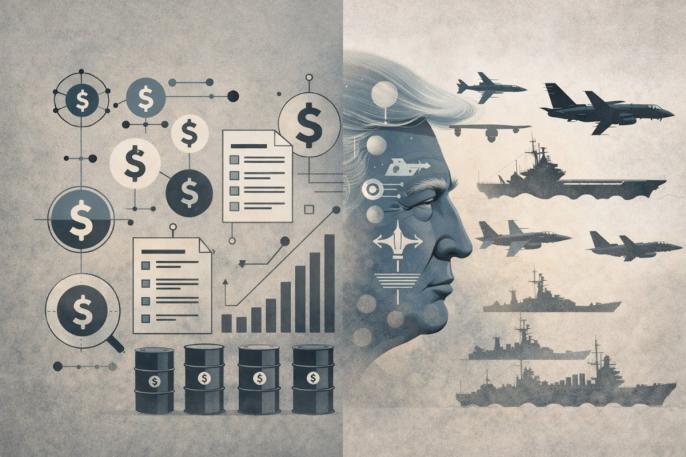
Anyone who explains the US intervention in Venezuela solely in terms of oil interests is missing a lot. Yes, oil plays a role — but the intervention must be understood as part of a much larger interplay in which energy, sanctions, security, regional dependencies, US domestic politics, and great power competition come together:
- Oil: Venezuela has the world's largest proven oil reserves, but that fact alone explains little. Production has been below one million barrels per day for years — a fraction of its historical level — due to structural underinvestment, technological erosion, and the massive exodus of technical personnel under Chávez and Maduro. A Venezuela that can bring 2–3 million barrels per day to market in the coming years — provided sanctions are selectively eased and capital returns — will have a deflationary effect, reduce geopolitical risk premiums, and increase US policy space.
- Strategic raw materials: At least as important, but much less visible in public debate, is Venezuela's position in the strategic raw materials chain. The south of the country has significant reserves of rare earth metals, niobium, tantalum, coltan, and gold. These are critical inputs for defense, semiconductors, energy transition, and high-tech production. The context here is crucial: China not only controls a large part of the extraction, but also virtually the entire processing of rare earth metals, and has explicitly shown its willingness to use export restrictions as a geopolitical lever. From that perspective, Venezuela is a diversification lever in a strategic security dossier that Washington considers increasingly urgent. The intervention does not create direct access to these raw materials, but it removes a regime that systematically exploited them via China, Russia, and criminal networks, and it potentially opens up a long, difficult but strategically valuable reorganization of raw material flows.
- Drugs: The role of drugs — and fentanyl in particular — is not a rhetorical side issue, but a domestic political driver. For years, the US has accused the Maduro regime of facilitating drug smuggling and acting as a logistics hub for Colombian cocaine and synthetic opioids, in collaboration with networks such as the Sinaloa cartel and Tren de Aragua. Fentanyl has now killed hundreds of thousands of Americans. That makes this issue not a matter of foreign policy, but of domestic crisis management. By criminalizing Venezuela — labeling the "Cartel de los Soles" a terrorist organization — Washington was able to move from sanctions to violence without having to frame it politically as war. This also legitimizes a permanent security presence in the region — at sea, in the air, and in financial networks.
- Cuba: Havana is structurally dependent on cheap Venezuelan oil (even before the intervention, Cuba struggled with power outages of up to 18 hours a day). With Maduro's departure, this relationship of dependency has been abruptly severed. The question is how long Cuba can survive without Venezuelan oil. Russia cannot fill that gap structurally: logistically, financially, and politically, that option is virtually closed, especially now that Washington is actively hunting down shadow fleets. The intervention in Venezuela thus functions as an indirect sanction mechanism against Havana by cutting off its economic lifeline. This makes the Cuba dossier likely to be inevitably unstable in 2026.
- The China–Russia–Iran axis: Finally, there is the geopolitical layer that connects everything. Venezuela is a hub of rival influence in the American backyard. Russia signed defense agreements, Iran supplied drone capabilities, and China anchored itself economically through loans, infrastructure, and raw materials. For Trump, the intervention fits into a renewed Monroe Doctrine: actively dismantling/combating enemy footprints in the Western Hemisphere. In doing so, US action in Venezuela reinforces the changes in states' thinking about risks surrounding reserves, trade routes, and dependencies on the dollar-based system.
The intervention in Venezuela was not an impulsive action or a purely monocausal grab for oil. It was the result of a convergence of interests: macroeconomic stability, strategic raw materials, domestic security, regional pressure points, and superpower competition.
The aftermath therefore revolves around the realignment of energy powers, regional dependencies, and global power relations. Whether that realignment remains manageable depends not only on military power, but also on political discipline and economic intelligence. Venezuela is thus a test case for how power and markets are intertwined and intersect in the new world order.
From military intervention to administrative reality
The American intervention has revealed how weak and eroded the Venezuelan state apparatus is. For years, ministries, security services, and the judiciary have functioned primarily as extensions of the regime, not as independent institutions. This is precisely why stabilization after interventions rarely fails due to a lack of military power, but because governance, legitimacy, and security are diverging; there is control on the streets, but no accepted authority, and there are political plans, but no institutions to implement them.
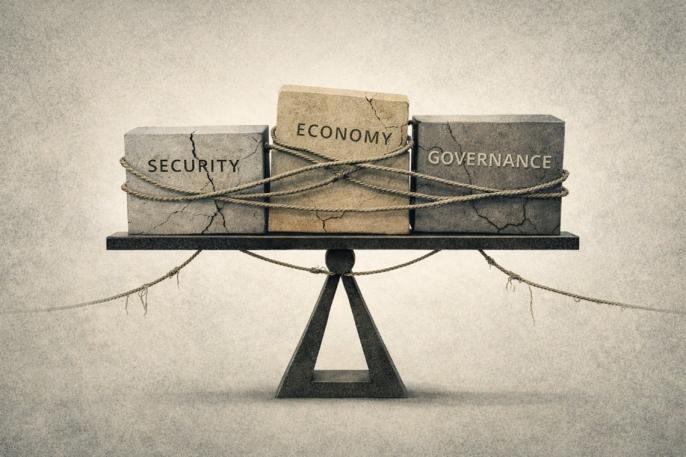
In Venezuela, this risk is exceptionally high. Actors must now reposition themselves in an environment where the old hierarchy is gone, but a new one does not yet exist. The closer Venezuela gets to a real transition, the greater the incentive for losing parties to sabotage that transition. This plays out on three levels:
Security: If amnesty and reintegration programs are too vague or too selective, armed actors will opt for violence. This is rational behavior in a context of uncertainty.
Economy: As soon as sanctions relief becomes credible, the stakes rise. Whoever gains access to oil contracts, import licenses, and infrastructure will win. This increases the risk of corruption, insider deals, and violence around economic hubs.
Politics: Elections without security do not create legitimacy but fragmentation. Premature democratization is a historically known pitfall.
Three potential paths for 2026
Based on the above, we now see three possible scenarios for Venezuela.

Scenario 1 — Managed transition with sanctions relief
In this scenario, Washington (and a provisional center of authority in Caracas) manages to steer the country through the first few months without the security apparatus or the economy completely fragmenting. This creates a certain degree of continuity in the army/police, limited amnesties or safe exits for parts of the old network, and a phased route towards elections. Economically, this will be accompanied by selective sanctions relief, investment opportunities for international oil companies, and the reopening of export channels.
This scenario is plausible, but slightly less likely than the second scenario, because the intervention is highly controversial from a legal and political point of view and because a transition fails mainly on the basis of trust and implementation — not on intentions. Markets seem to be leaning toward the "relatively stable transition option": Venezuela's government bonds and PDVSA debt securities jumped sharply after Maduro's kidnapping, implying that investors are pricing in a serious chance of restructuring and normalization.
Scenario 2 — Unstable continuity
This is the most likely path: Maduro is gone, but the power network remains. Caracas tries to organize administrative continuity (with figures such as Delcy Rodríguez in a key role), while Washington continues to apply pressure and at the same time struggles with the question of legitimacy at home and internationally.
In this scenario, there will be no major civil war, but rather a combination of intimidation, selective repression, small-scale economic sabotage, criminalization of politics, and an oil flow that continues to falter due to neglected infrastructure and the ongoing sanctions architecture.
This scenario is narrowly the most likely, because the US intervention has removed the political head of the regime but left the underlying power system largely intact. This prevents both a rapid collapse and a real breakthrough. At the same time, Washington clearly wants to control without taking over: no occupation, no large-scale reconstruction, but continued pressure. This rules out a real transition for the time being, but also keeps fragmentation within limits for now. The sanctions strategy reinforces this pattern: there is enough pressure to maintain influence, but no credible easing that would trigger investment and recovery. In addition, domestic US politics is slowing down further escalation or long-term involvement, while withdrawal without results is equally unattractive. The result is an intermediate phase in which Venezuela continues to function without stabilizing: unstable continuity.
Scenario 3 — Fragmentation and escalation
This is the tail-risk scenario. In this scenario, no single authority manages to consolidate its monopoly on the use of force. Security services become fragmented, criminal networks and paramilitary groups gain greater autonomy, and incentives for sabotage of oil and port infrastructure increase. The conflict then becomes less "US versus Venezuela" and more "Venezuela as a playing field for competing armed collectives."
Although this path is the least likely, we should not underestimate the chances of it happening. If we had to put a concrete percentage on it, it would be around 20-25%, because the intervention creates both a governance vacuum and a legitimacy conflict. Moreover, if the Trump administration comes under domestic pressure, this could lead to half-hearted follow-up measures: just enough intervention to break the old balance, but too little political space to stabilize the situation.
Global implications
In the long term, Venezuela is less important for what happens within its borders and more for what the intervention normalizes. With this intervention, Washington is confirming a trend that was already visible but is now becoming explicit: sanctions are no longer exclusively a financial or legal instrument, but are part of a broader strategy to exercise power and redraw geopolitical lines. This is shifting the way states, companies, and investors assess risk worldwide.

For many countries, the lesson is clear. Dependence on a single financial system, a single reserve currency, or a single legal order makes countries increasingly vulnerable. The logical response is to accelerate alternatives: more bilateral trade outside the dollar, diversification of reserves, alternative/additional logistical supply routes, and payment channels that are less exposed to US enforcement. Financial and economic fragmentation thus becomes a rational insurance strategy against geopolitical coercion.
The precedent also has geopolitical implications. Unilateral US action in its own hemisphere reinforces the narrative of rivals that international rules are applied selectively and that power ultimately outweighs procedure and rules. That narrative is not only used in Latin America, but also resonates in issues such as Taiwan, the South China Sea, Ukraine, and future sanctions conflicts elsewhere.
For investors and policymakers, there is an uncomfortable but clear conclusion here. The intervention in Venezuela is not an end point, but a tipping point. In the short term, volatility and narrative battles will prevail. In the medium term, it will become clear whether Washington is capable of managing a limited transition or will unwittingly end up in a long-term security role. In the long term, the global risk framework will shift: energy, sanctions, financial systems, trade, and power politics will become more structurally intertwined. In that respect, there is a risk that Venezuela will not turn out to be an exceptional case, but will instead become the blueprint for how power is exercised in the new world order.
- Stay tuned for more in our Global Political Analysis section. No access yet? Request it here.

